


By Jael Masury, Project Manager Solutions, Omexom Renewable Energies Offshore GmbH
Partial discharges are a well-known but often underestimated risk in high-voltage systems. In offshore wind farms, even minor defects in cable terminations, connectors or switchgear components can trigger ionization processes that ultimately lead to electrical breakdown. The result is component failure, production losses in the million-euro range, and repair campaigns requiring significant offshore logistics.
With ACOUSTISCAN, Omexom and the Austrian startup Seven Bel have developed an acoustic partial discharge monitoring solution that identifies partial discharges at an early stage using ultrasound rather than conventional electrical measurements. The technology enables continuous condition monitoring and helps improve offshore wind reliability and long-term asset integrity.
From Acoustic Camera to Offshore Monitoring System
The foundation of ACOUSTISCAN is Seven Bel’s patented sound scanner. During a startup collaboration event hosted by VINCI Energies’ innovation platform Leonard, Omexom’s offshore engineering teams recognised its further potential for continuous partial discharge detection in high-voltage applications.
Partial discharges emit characteristic acoustic signatures in the ultrasonic range. By combining adapted sensor hardware with dedicated analysis software, the partners created a solution capable of detecting these signals in offshore environments and supporting continuous high-voltage insulation monitoring.
Why Early Detection Matters Offshore
Small imperfections such as air pockets or micro-defects in high- and medium-voltage connectors can ionize under electrical stress. Once ionization occurs, insulation degradation accelerates and can ultimately lead to component failure.
Offshore, this can result in:
· Production losses of €1–5 million per incident
· High repair costs due to vessel mobilisation and weather windows
· Extended downtime in critical electrical infrastructure
Early identification of partial discharge activity is therefore a key element of modern condition-based maintenance and proactive asset management.
How ACOUSTISCAN Works
ACOUSTISCAN continuously records ultrasonic emissions and visualises them as colour spectrograms, where colour intensity represents sound pressure levels (SPL). During each measurement interval, the software automatically identifies acoustic events that deviate from baseline conditions.
Detected anomalies are analysed using Phase Resolved Partial Discharge (PRPD) diagrams, which map acoustic activity to the phase position of the electrical voltage. This enables engineers to indicate the severity of the observed deviation to their clients.
Characteristic patterns within relevant frequency ranges indicate developing partial discharge activity long before visible damage occurs.
Reliable Monitoring in Offshore Conditions
Environmental sounds such as wind and waves do not interfere significantly with the analysis because they exhibit different acoustic characteristics. As a result, ACOUSTISCAN enables reliable switchgear monitoring, cable connector monitoring and electrical asset monitoring even under harsh offshore conditions.
Tested, Validated and Deployed
Since January 2025, ACOUSTISCAN has undergone extensive testing in high-voltage laboratories, onshore substations, offshore substations and wind turbine connection fields.
The technology was validated at Kiel University of Applied Sciences and tested against established industry practices. Today, approximately 60 sensors are installed across offshore substations and 20 sensors are installed on turbine switchgear systems, providing valuable operational data for preventive maintenance and reliability management.
Full-Service Monitoring
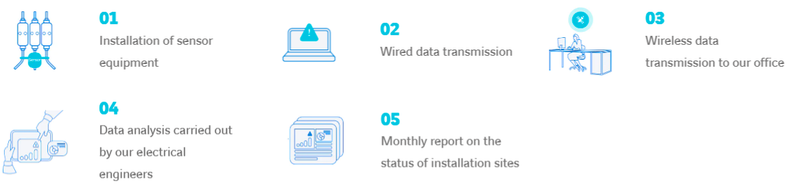
Omexom delivers ACOUSTISCAN as a complete service package, including:
· Requirements analysis
· Sensor installation and configuration
· Secure data transmission
· Automated software evaluation
· Expert engineering review
· Monthly reporting and recommendations
If partial discharge activity is detected, operators receive early warning so that corrective measures can be planned before a failure occurs.
Towards Predictive Maintenance
The next development step is predictive maintenance. By correlating historical acoustic measurement data with findings from replaced components, Omexom and Seven Bel aim to improve the prediction of component degradation and remaining service life.
The long-term objective is to enable operators to transition from preventive maintenance schedules to fully condition-based maintenance strategies.
Innovation Through Collaboration
ACOUSTISCAN demonstrates how collaboration between startups and established industrial companies can accelerate innovation. For offshore wind operators, the result is a practical and technically robust acoustic partial discharge monitoring solution that enhances safety, reduces downtime, supports offshore wind asset integrity, and enables smarter management of critical high-voltage infrastructure.
By capturing ultrasonic signals that have long remained unnoticed, ACOUSTISCAN opens new opportunities for predictive maintenance and reliable operation of offshore wind assets.

Note: The opinions, beliefs, and viewpoints expressed in this article do not necessarily reflect the opinions of offshoreWIND.biz